
By Cecelia Otis
Skip wandering around looking for something to do — there is a powerful, moving show coming to Scranton. Valerie David is a performer and artist that has been using comedy and improv to tell her incredible story. She has been through many challenges and obstacles and turned her journey into moving, yet funny stories that relate to audiences. Her show, Baggage From BaghDAD: Becoming My Father’s Daughter, tells a story about her family heritage and the injustice they experienced, and how we need to move toward peace. I had the pleasure of interviewing Valerie and learning more about her journey and heritage. In the interview, I asked her about her battle with cancer, her interesting family heritage, and how she is using her shows to highlight the injustice and discrimination in the world. This is my “7 Questions with Valerie” interview, and I hope you learn something interesting and inspiring from her and her journey.
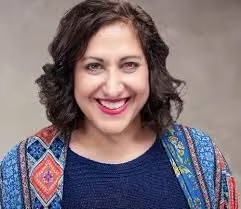
- You previously performed at the Scranton Fringe Festival in 2017, with your show The Pink Hulk: One Woman’s Journey to Find the Superhero Within. What initially interested you in the performing arts?
Ever since I was a little kid, I always loved performing—I think it stems from being the youngest of 3 girls—always the ham, the want-to-be comedian! My mom told me when I was about 4 years old, I would sit in front of the TV and yell, “Help help—I am stuck in the TV,” but not in the creepy Poltergeist kind of way! It was a positive experience! LOL! When I moved from Richmond, Va., to Virginia Beach, I started taking drama classes in high school and was bitten by the musical theater bug—landing the role of Frenchie in Grease. I had to learn how to roller skate for the Beauty School Dropout number. In the actual performance, doing the “Shoot the Duck” roller-skating move where you squat low to the ground with one leg sticking out, I lost control and crashed midway onstage. I was mortified. Here I took these dang lessons, but that mistake turned into a golden moment…I crawled off the stage on my hands and knees, and the audience roared with laughter. That was when I discovered improv. “Improvising” my way out of my skate debacle, and it turned into a “bit”! I was officially hooked at that moment, and have pursued acting and improv ever since!
- Your previous performance chronicled your battle and journey as a 3-time cancer survivor. How has this time in your life changed you? What helped you persevere and conquer your fight?
Being a 26-year, three-time cancer survivor really shaped who I am today. I appreciate each day, have become a more empathic person, and have learned to not sweat the small stuff all the time. Believe me, I still do sweat the small stuff, but I can let go of angst a lot faster and let things go. If something bothers me, I say to myself, “Valerie, why are you getting so worked up?—look what you’ve been through! Stop the madness!” And then I do! I also look at the strength cancer has given me to stand up for myself and be my own advocate both as a patient and also in my life in general. With that adage, “If you see something, say something”—I do. What has helped me persevere and conquer this fight is being surrounded by my wonderful family, an incredible circle of friends, and great doctors who believed in my recovery and survival.
- In your new show, Baggage From BaghdDAD: Becoming My Father’s Daughter, you tell a story about your late father, David David, and how his experiences not only shaped him, but you as well. What can you tell us about your father? Any fond or favorite memories with him?
Yes, my father’s name is David David—we used to say about my dad, “David David is so nice, they named him twice!” One of the most valuable things he taught me was to be accountable for your actions and to appreciate even the little things in life—not to take anything for granted. He and his family had to flee Baghdad in 1941 because of religious persecution—with only what they could carry, never to return. His courage and strength to overcome such trauma inspired me to also have that courage—and family was everything to him. My dad treasured family time with my mom, me, and my sisters. I took my parents on a cruise to Bermuda a few years back, where they honeymooned. My mom, dad, and I were on the deck of the ship. He was in a suit and tie, just looking out at the ocean with such an expression of joy and this inner peace on his face. I was so moved by this that I snapped a photo of him while he wasn’t looking—and the picture captured who he was and how he felt about life. It is such a fond memory of my dad.
- Your new show talks about your family, especially your father, and how he and his family escaped Iraq during the 1941 Farhud, a two-day spree of anti-Jewish violence. What can you tell me about that discovery? How did it shape your and your family’s life?
It was not until later in life that I knew what my dad and my family really went through. He never wanted to talk about what happened to his family. I had seen an amazing documentary, The Last Jews of Baghdad: End of an Exile; Beginning of a Journey, which was presented at the New York Sephardic Jewish Film Festival at the Center for Jewish History by award-winning documentarians Carole Basri and Adriana Davis. My parents went with me. The Farhud and its devastating impact on the Jews of Baghdad was part of this documentary, along with the rise of Anti-Semitism in The Middle East at that time. I was so inspired by this film that I decided I wanted to film my family to record their story of their evacuation during The Farhud to India and then to the U.S. to start a new life. I filmed my dad and three other family members. I did not think at the time that I would be writing a play about it. I just wanted to record their stories and preserve our family history. In recording their heartbreak, bravery, and resilience, it started to inspire and empower me. I was diagnosed with cancer two more times after filming them and their stories of survival—and I have no doubt that is why I survived.
- In an article with the Times Leader, you mentioned that you experienced discrimination by an old classmate and in your own neighborhood. What can you tell me about these experiences? How did they make you want to speak out against adversity and discrimination more?
Growing up in the South, I was usually the first Jewish person anybody ever met at school. As a young kid, especially in third grade, I was bullied, more so for being like the Linda Fischer character in Judy Blume’s novel Blubber—that overweight, unathletic kid who was made fun of—always the last one picked on sports teams and failing every physical fitness test. But then in middle school—that is where I felt the discrimination for being Jewish began. That made me realize how important it is to embrace who you are and stand up for your beliefs. And to this day, I hold steadfast to speaking up. Baggage From BaghDAD is a story that offers both historical education and emotional resonance. It’s not just a Jewish story, but a narrative that anyone can relate to, with having to emigrate to another country, being forced to evacuate during wartime, suffering bullying, and the ramifications of having to adapt to a foreign culture that’s not so welcoming. And my family’s personal narrative mirrors broader global issues, from the struggles of Ukrainian and Gaza refugees to the current resurgence of Anti-Semitism to religious discrimination worldwide.
- You have said that you are grateful to see your show, Baggage From BaghdDAD, is helping to build connections with other people. What has that experience been like for you? Any fond memories from these connections?
I am truly grateful for the connections this show has been building. Not only does it address prejudice and discrimination, but it is also the story of the love and connection between a father and his daughter—that even with the many bumps along the way in that relationship, there is redemption and reconciliation that evolved in this familial bond. Love always triumphs! One of the most significant experiences came after a performance in Vermont when a Muslim gentleman came up to me and shared that he had to flee Iraq in 2005 with his daughter. He was so moved by my story, relating completely to my dad’s experiences, that he felt an instant connection. He told me, “We are family,” and gave me a huge hug. That just because we were of different faiths, we were the same—it didn’t matter that I was Jewish and he, Muslim. Baggage From BaghDAD is an important play that has a message of hope and highlights the importance of family that we can all relate to and sheds light on the sacrifices and struggles of those who are forced to leave their homes and begin a new life in a new country.
- For anyone else who has had similar struggles or is going through discrimination, what can you tell them? Any advice that helped you?
With The Pink Hulk, with its tagline “One Woman’s Journey to Find the Superhero Within,” I hope to help those facing adversity in their own lives to find their inner superhero to help them overcome obstacles in life—to never give up hope, even in the darkest times. It is a show not just about cancer—it has a universal message of hope and empowerment, living life on your own terms, and being your own best advocate.
With Baggage From BaghDAD, the message is that there is no place for discrimination and prejudice. We need to celebrate our differences and uniqueness. This play, spotlighting The Farhud, promotes tolerance and acceptance and embracing our differences. Through the play’s vivid characters, humor, and heart, the play invites audiences to examine today’s refugee crises, rising prejudice, and the intergenerational impact of war and displacement. History must not repeat itself.
Valerie David’s show will be performed at the Scranton Fringe Festival on September 26th and 27th, 2025, at the Workshop. Tickets are on sale now – just click here – and come see Baggage From BaghDAD!