By Cecelia Otis
If you’ve ever wanted an interesting way to think about the human experience, actor and performer Tannis Kowalchuk does exactly that with her show Decompositions, slated to be performed at Marywood University later this month as part of the 2025 Scranton Fringe Festival. Being a co-founder of Willow Wisp Organic Farm, she blends what she knows about agriculture into a beautiful performance of life and death. This is my “7 Questions with Tannis” interview, and I hope you learn something interesting about her and her work!
You have been performing, directing, and organizing numerous shows and productions for a very long time. What interested you in performing arts? How did you get started?
I don’t know what got me interested, but from age 5, I simply wanted to make shows, and so I forced my younger sisters to put on plays with me. And then I forced all the grownups around to watch us. Nothing much has changed.
You attended the University of Winnipeg and received a Bachelor’s Degree in Theatre. When did you realize that you wanted to pursue theatre as a career? Any inspirations that helped you in starting your theatre journey?
I went to university to study theatre with the intention of becoming a professional actor. I had great teachers there who introduced me to Brecht and new plays. I also worked with a guest teacher who taught at the University of Winnipeg for a few years. Alan Williams was a member of Hull Truck in England, and filmmaker Mike Leigh was his big influence. We worked closely with him and created/devised plays through improvisation. So early on, ensemble theatre really attracted me. Making plays from scratch and with people in a group seemed the most exciting theatre. We called ourselves The Rude Players.
After college, you worked with the Primus Theater in Canada, directing and performing in numerous shows. How did this opportunity come to you? Any fond or favorite memories from this time in your life?
I saw Primus at the Winnipeg Fringe Festival and was gobsmacked by their highly physical and experimental work—like nothing I had ever seen before. So I asked if I could start training with them. They invited me, and the training was intense. Our director was an actor from Eugenio Barba’s Odin Teatret in Denmark. I became a member of this five-actor troupe and worked with Primus for 7 years—a proper apprenticeship. We toured Canada and Europe constantly, and this experience is what has influenced me most as an artist. Again, making original plays with a company, finding ways to survive, training every day even when there is not a show, writing grants, getting gigs, and teaching methodology. It’s a great way to stay alive and keep working as an artist.
Aside from your personal work, you are also a co-founder of the North American Cultural Laboratory (NACL) Theatre. What prompted the establishment of this theatre? Was there a specific mission or inspiration for the theatre?
When I left Primus, I wanted to move to New York City and start a new company. La Mama ETC in the East Village hosted us, and Brad Krumholz and I started the North American Cultural Laboratory. We worked downtown for a spell and then moved our operations to upstate New York where I co-ran an artist residence and theatre venue for many years. Our focus was to create and support groundbreaking experimental theatre. The company is still an active space, but I left in 2018 to start Farm Arts Collective on my farm. I started farming in 2009, and my priorities were shifting to site-specific, environmental-themed work. And I wanted to develop a local company of players to do this—to work with the people where I live.
With all of your amazing work, you are also the Artistic Director for the Farm Arts Collective, where you specialize in devised theater and creative placemaking projects. On the Farm Arts Collective website, you are quoted as saying that the collective is a “dream come true.” Can you elaborate on that? What kind of impact does the Farm Arts Collective have on the community?
My goal now is to use theatre to make a radical change and difference in the lives of the doers and viewers. I also want to uplift farming and sustainable living practices because our farm can teach us and our community so much. The Farm Arts Collective’s mission is to intersect farming, art, food, and ecology to create a healthy space, to nourish mind, body, and soul.
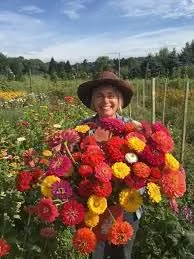
The Farm Arts Collective headquarters is on Willow Wisp Organic Farm, a solar-powered organic farm in northeast Pennsylvania, which you co-own. For those who have never heard of the farm, what can you tell people about it?
We are a 25-acre solar-powered organic vegetable, flower, and herb farm located on the Delaware River from which we irrigate. We built a new barn in 2024, and Farm Arts Collective occupies half the space. Last year, we raised money and built out an Agri-Cultural venue for performances, farming workshops, and community happenings. One of our biggest events is called Dream on the Farm. We are making 10 plays (one per year) about climate change. This year was our 6th performance, directed by me. It is an original site-specific play, every summer created over months of work by a collective of 25+ local actors, musicians, farmers, and activists. We also host countless farm, food, and ecology workshops and farm tours. In fact, Marywood students came for a visit this year!
Your solo show is called Decompositions, which will be performed at the Scranton Fringe Festival. What is your show about? What can audiences expect to see?
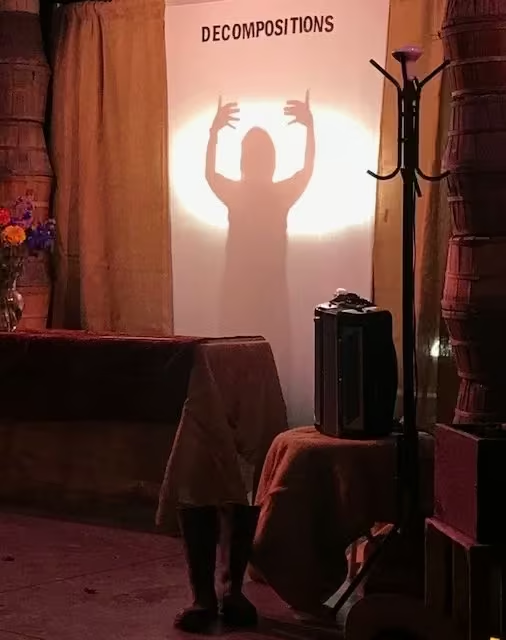
Decompositions is a very personal work written and performed by me and directed by Mimi McGurl. I perform a duet with a large pile of compost from the farm. It is a music-filled, storytelling, and physical exploration of how our cycle of life mirrors that of the decomposing process. We are all constantly changing, losing, aging, and facing disruptions, and yet if we let it happen, the loss and the discarding of “old stuff” can transform into a beautiful thing called humus—and it is an elegant and natural step toward new growth and unexpected possibilities. The show is energetic, humorous, honest, and full of life and death—if we can face it. I just performed at an international theatre festival in Serbia in August, and I wasn’t sure how the performance would translate to a Serbian audience. But they really loved it, which gave me so much confidence as I move onward with the show. I do look forward to sharing the work in Scranton.
Tannis’ show Decompositions will be performed at the Scranton Fringe Festival from September 26th–28th, 2025, at Regina Hall on the Marywood University Campus. This performance is defintely going to be one to check out at this year’s Festival!