
By Cecelia Otis
If you’re looking for something to do on the weekend, there is a performance of four original plays coming to Scranton. Cari Tellis is a professor in the Speech-Language Pathology Department at Misericordia University. She founded an organization called PATAsphere to help other performers learn and grow in a safe space. This organization is bringing a bunch of 10-Minute plays, written by graduate students in the Wilkes University Creative Writing program, to life. I had the opportunity to interview Cari, and learn more about her work experience and profession. In the interview, I asked her about how she got started in speech pathology, what kind of work she does, and her creative writing journey. This is my “7 Questions with Cari” interview, and I hope you learn something interesting about her work.
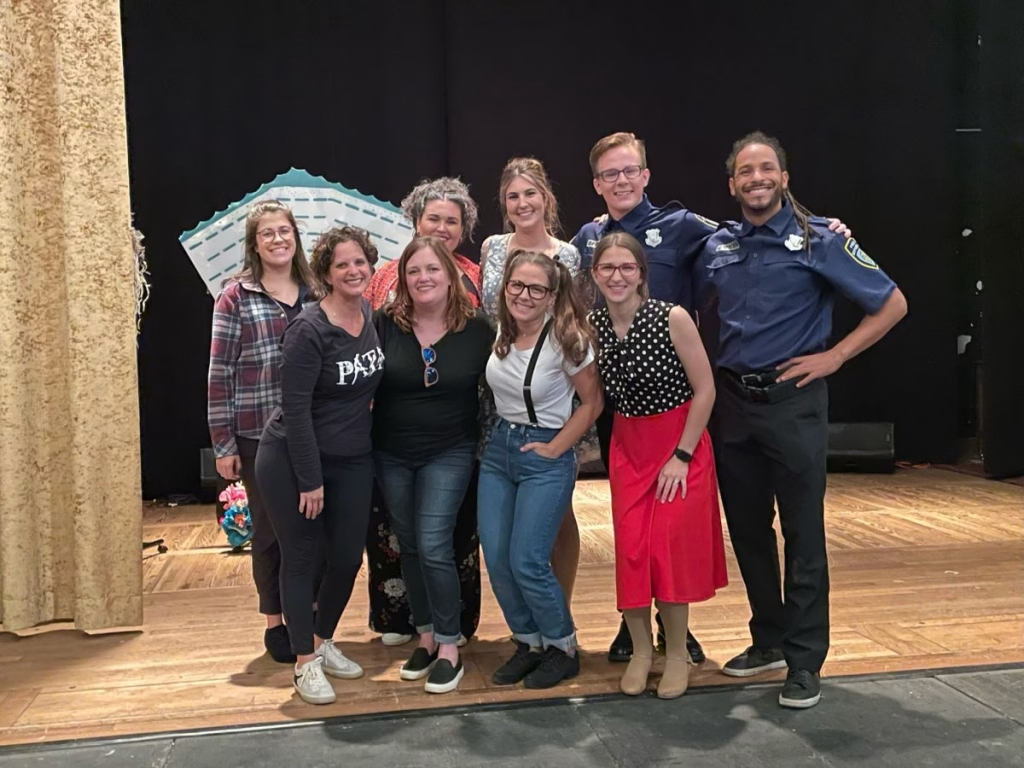
- You are a professor in the Speech-Language Pathology Department at Misericordia University and have been practising in the clinical field for over 20 years. What interested you in this field? How did you get started?
My favorite uncle had a stroke when I was in high school. I had the opportunity to watch some of his speech therapy in the rehab he was in for some time before he went home. I knew at that point that I wanted to work with people to help them be able to communicate. It wasn’t until the summer between the first and second years of graduate school when I learned that speech-language pathologists work with people who have voice problems. Being a singer and a performer, I knew I found the area I wanted to specialize in. I love being a part of helping people get their voice back.
- You completed your training in voice disorders at the UPMC Voice and Swallowing Center in Pittsburgh, PA, and have worked in several different places since. What kind of work do you provide people? Can you elaborate on some practices?
Yes, I did my fellowship training at the UPMC Voice and Swallowing Center. I’m grateful that I got experience in that setting. I saw outpatient voice and swallowed rehabilitation. I also have patients in inpatient rehab, inpatient medicine floors, and inpatient acute care. In those settings, I got a lot of experience working with people who had all different types of speech, language, cognition, swallowing, and voice issues due to brain injury, strokes, surgery, cancer, laryngectomy, and many other issues. I now work as Professor at Misericordia. I teach undergraduate and graduate students about Speech-Language Pathology. I stay involved clinically and run an SLP private practice in Wilkes-Barre. I’m a teacher, clinician, researcher, and scientist. I also work with young performers in the performing arts teaching them how to sing and act.
- Aside from your extensive experience in assessing and treating voice disorders, you are also an Estill Master Teacher (EMT) and Estill Mentor and Course Instructor (EMCI). Can you tell us more about your experiences? What does being an EMT and EMCI mean exactly?
I’m certified as an Estill Mentor and Course Instructor (EMCI) in the Estill Voice Model, a model of vocal anatomy and physiology. Jo Estill was a singer, researcher, and scientist who wanted to know how she could sing the way she could sing. She started doing research and she developed a voice model to explain the different parts of the human anatomy that can be modified to make different sounds. I’ve worked for almost 20 years to apply this voice model to voice rehabilitation and training. You can check out more about the Estill Model at www.estillvoice.com. There are only about 30 EMCIs in the world. I’m honored to have this distinction and look forward to continuing my research and training in this area of the field.
- Some of your research has had a great impact on the methods of voice instruction and how it is approached. What kind of research led to this discovery? What does this kind of impact mean to you?
I love learning and I love learning about learning. Not everyone learns in the same way. In my research and clinic career, I have worked to find methods of instruction that can help all different types of learners. Traditionally, voice has been taught in one way – mostly through implicit (model-mimic) types of training. I’ve integrated explicit instructions (telling someone how to do the task) with implicit facilitators to improve learning. I researched motor learning and applied the newest theories of motor learning to voice instruction.
- You founded an organization called PATAsphere that provides performers with state-of-the-art voice, drama, and dance lessons in a safe environment. You are also a singer yourself. How did the idea for this organization occur? What has PATAsphere meant to you and others?
When I moved to the area almost 20 years ago, there were a lot of people who wanted private voice instruction. I decided to start PATAsphere so that I could work with a lot of different people and not have to limit who I was able to teach. PATA started as a Summer Camp. The kids who attended camp kept requesting that I hold classes throughout the year, so that’s what we did. Our summer camp trains young performers in all aspects of the performing arts and culminates with the performance of an all-original musical. PATAsphere’s mission is to create a safe and engaging place where kids can come and be themselves, express themselves without fear of judgment. Be kind. That’s at the core of our mission. We often say, what’s the kindest thing you can do for yourself and others. The arts can be used to teach so much more than the craft of performance. It teaches people how to work together. It teaches emotional investigation and intelligence. It teaches us all how to be the best and truest versions of ourselves. I think that’s what PATA has meant to others. It means that they have a place to come to where they are accepted and loved. All the staff at PATA share those same values.
- You are a part of a performing arts show titled A Series of 10-Minute Plays, where you are one of four people who wrote and will present their own “10-Minute Play.” How did you get involved with this production? Any fond or favorite memories?
Last January, I started pursuing my MA in Creative Writing in the Creative Writing Program at Wilkes University with a focus in playwriting and poetry. My classmates and I worked hard in our playwriting class, and I thought it would be great to see our plays live. I submitted our 4 plays as a series of 10-min plays to the Scranton Fringe Festival and they got accepted. PATAsphere is producing the show and I’m directing. I will be the MC of the night. I’m really so impressed by these four shows and all the actors performing. I think that’s my favorite part. Watching these actors interpret the words and bring them to life on stage.
My writing team, which consists of Lonnie Barone, and my partner, Katharine McElroy, has been writing all-original musicals since 2014. Lonnie has been our primary writer for many years and I have taken on the primary role as editor. Together we have written 6 all-original songs, each of us contributing to lyrics, and Katharine being the primary music writer. In the interlude between plays, I will be reading poems and then a performer will be singing the song that was born out of the poem. This past summer, the kids at Summer PATA performed a solo script I wrote called, Duets for Dez. Katharine, Lonnie, and I all contributed to the lyrics and Katharine wrote the songs. That give us 7 all-original musicals in all and over 110 original songs.
- Since you wrote your own play for the show, is there anything you can tell us about your play? What can audiences expect to see or hear?
My show is about Amber, an 18-year old, who struggles with anxiety and depression. She wants to leave her confining, small town and go to college. The monster, who lives under the bed, tries to convince her that she is too scared and too nervous to go to college. Will Amber listen to Monster or break free of the past that confines her? It’s a special play to me as I’ve been very interested in learning about teenage mental health and Internal Family Systems. We all have these parts that just want to be heard and validated. Some of those parts can seem scary or threatening, but none of them are bad. “There are no bad parts.” If we can take the time to talk to our parts and show them compassion, we can learn more about them and why they feel they need to respond in the way they are responding. That’s what Amber does with Monster. She talks to him to get to know him. Once heard, she’s able to tell him that she grew up and doesn’t need him scaring her anymore.
I love all the shows that we are doing. My classmates are so talented. I had so much fun reading their work during our class. I also was incredibly fortunate to get their feedback. They’re all so smart, creative, and imaginative. If you’re looking for a great night, come out on Friday at 7:30pm at the Electric Trolley Museum in Scranton.
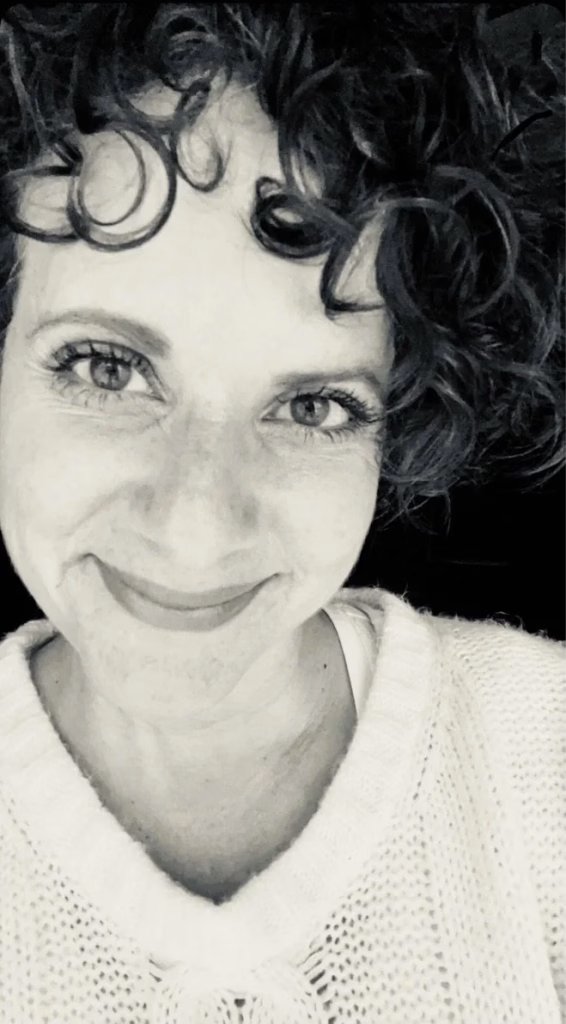
Suggested Audience – 18+ (strong language)
Cari Tellis’s show will be performed at the Scranton Fringe Festival on September 26th, 2025, at the Trolley Museum. Tickets are on sale now – just click here to snag yours!
*The suggested audience for this show is 18+ due to strong language and mature themes, so please keep that in mind when purchasing your tickets.